Anatomy of a capsule: lesson, challenge, evidence
The indivisible unit of Mi Campus, the five challenge types with a health example for each, and how rubrics, attempts and time limits work
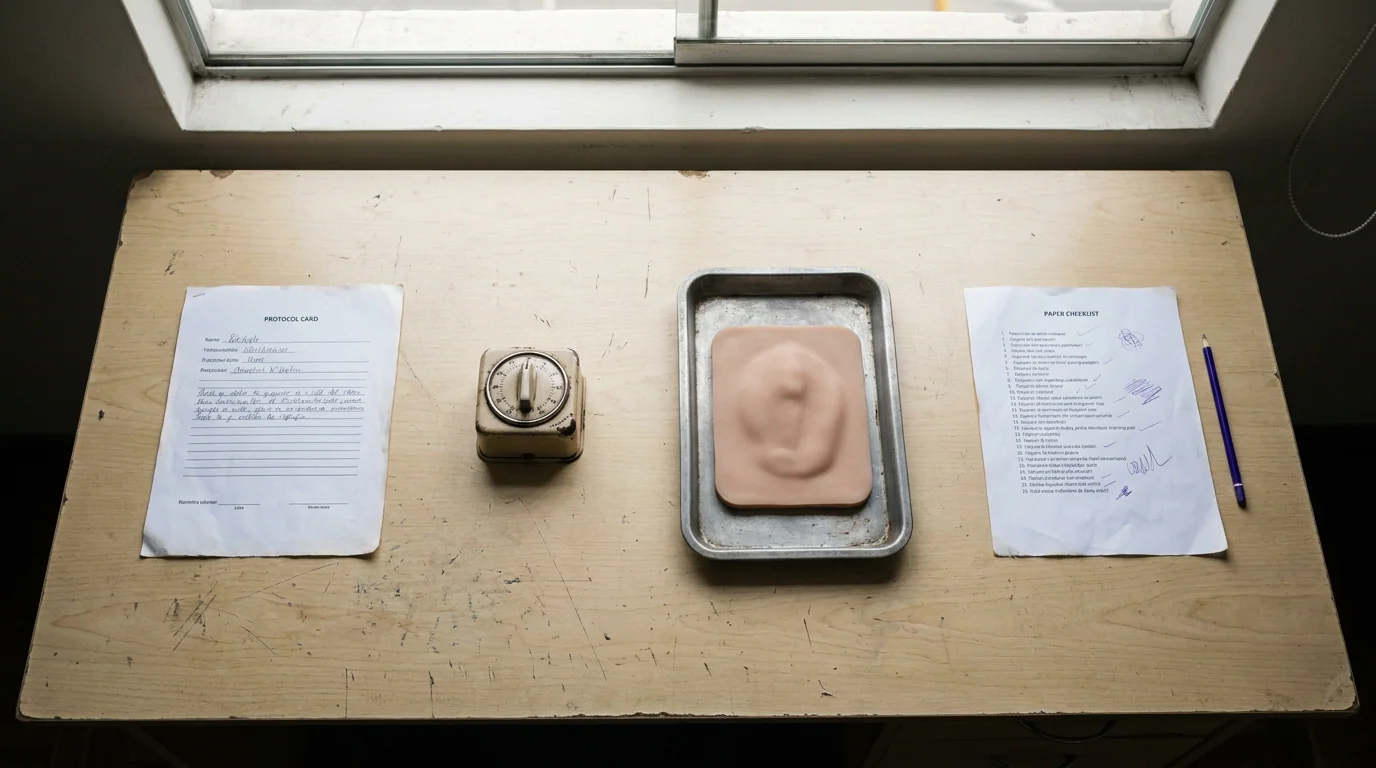
Take a capsule apart and you find three pieces. Remove any one of them and it stops being a capsule.
The first is a lesson. The second is an activation challenge. The third is the competency evidence the challenge produces. In a traditional course these live in different places: content in one module, a quiz at the end, a grade in a spreadsheet. In Mi Campus they are one object, and a learner cannot finish the first piece without going through the other two.
The lesson: only what the challenge needs
A lesson in a capsule is short by design. It can be a brief video, a text, a diagram, a document or a checklist to study. What it cannot be is comprehensive. Its job is to give the learner exactly what they need to solve the challenge that follows, and nothing more.
This rule changes how instructors write. Instead of asking “what should people know about this topic?” they ask “what does someone need in order to do this specific thing correctly?” The answer is almost always shorter than the existing slide deck. Anything that does not help solve the challenge gets moved to another capsule or removed.
Five challenge types, five health examples
Every capsule ends in one challenge, and there are five types to choose from. Here is each one with an example from health training, where Mi Campus started.
Case. The learner receives a situation and has to analyze it and respond. Example: a patient arrives for an intravenous infusion; the learner describes how they would prepare the workspace to maintain aseptic technique, which barriers they would use and in what order. The response is evaluated against a rubric that lists the steps a correct answer must contain.
Decision. The learner is placed at a decision point with a small number of options, each with consequences. Example: given a patient’s weight, the prescribed concentration and the available presentation, the learner must choose the correct dose to draw up. A wrong choice is recorded as a specific error, not just a failure.
Submission. The learner produces something and delivers it. Example: complete a clinical record form for a simulated encounter and submit it. The rubric checks that mandatory fields are present, that the entries are consistent with the case and that nothing forbidden was recorded.
Checklist. The learner runs through a procedure step by step, confirming each one. Example: the cold-chain checklist for receiving vaccines: temperature verified on arrival, reading logged, storage placement, alarm check. The order and completeness are what is evaluated.
Quick assessment. A short set of questions that test application rather than recall. Example: five scenarios, each asking whether a described patient has a contraindication for a given vaccine and why. It is fast, but every question requires applying a rule to a case.
The type is chosen by the instructor to match the skill. Recognizing a contraindication is a quick assessment. Preparing a sterile field is a checklist. Choosing a dose is a decision. None of them can be passed by watching.
Rubric, attempts and time limit
Each challenge carries four settings that the institution controls.
The rubric describes what a correct response contains. It is written by the instructor and it is what the evaluation is based on. The passing criteria state what counts as passed. The maximum number of attempts limits how many times a learner can try; some skills warrant three attempts, others only one. The time limit, when used, adds the constraint of working under the clock, which matters when the real task also has one.
These settings are yours. The platform records the outcome, the attempts, the time and the errors, and applies the criteria you defined. It does not replace them with its own judgment. Where the Sommatic AI assistant is enabled, it helps people move and act inside the platform; it does not decide whether a challenge was passed.
Core and reinforcement
Capsules come in two kinds. Core capsules are the mandatory sequence of a program; every learner has to complete them. Reinforcement capsules are written for a specific error. They stay hidden and are prescribed only to learners whose results show that error.
A reinforcement capsule has the same anatomy: a lesson that addresses the specific gap, a challenge that tests whether it is closed, and the evidence that it was. The difference is who sees it and when. A learner who gets the dose calculation right never sees the reinforcement capsule on unit conversion. A learner who gets it wrong for that reason does, before moving on.
If you are designing your first program, start with a single core capsule. Pick one skill, write the shortest lesson that enables it, choose the challenge type that matches, and write the rubric before anything else. Mi Campus has a free plan for building and running exactly that.