Watching is not learning
The gap between knowing and doing, why view counts are the wrong metric, and what counts as evidence that someone actually learned
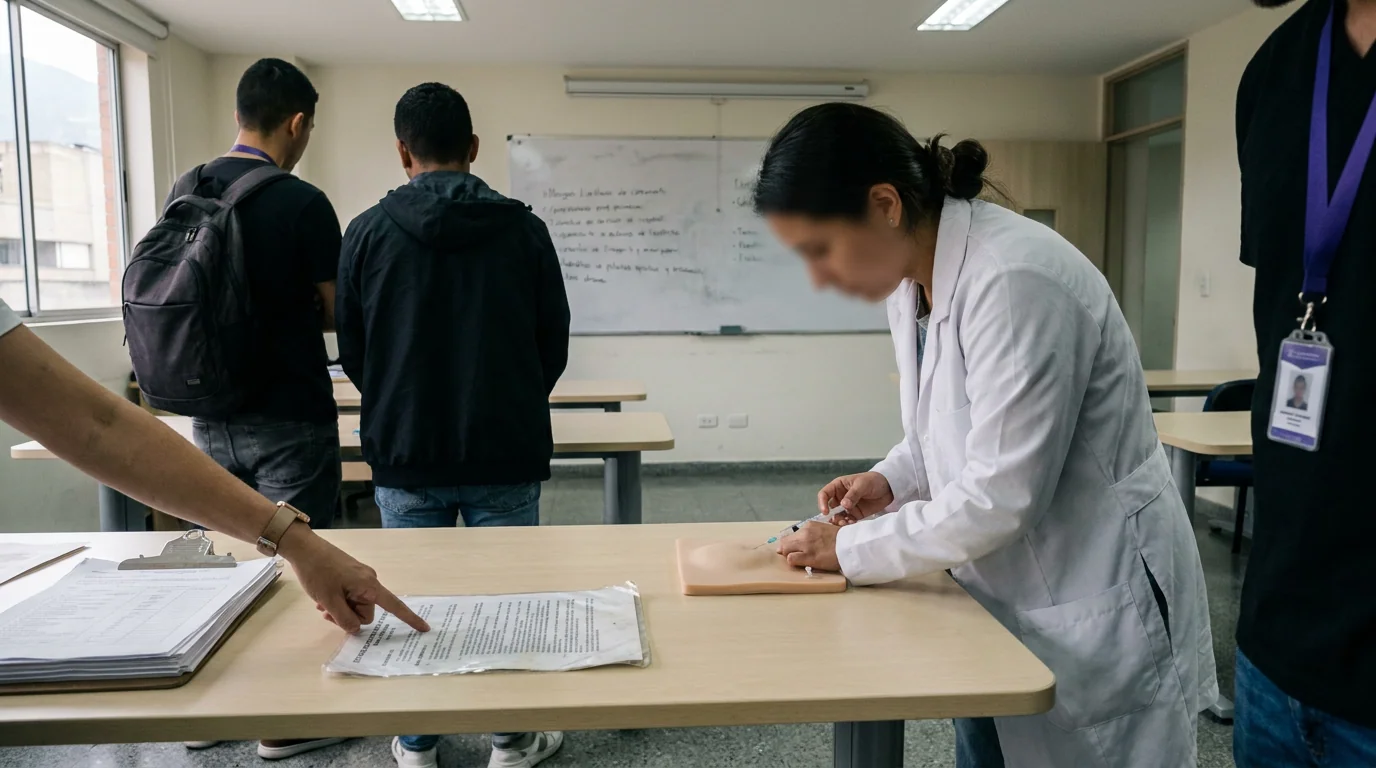
A nurse finishes a forty-minute video on aseptic technique. The platform records it: 100% watched. Nobody in the room knows whether she can set up a sterile field.
That is the situation most training platforms leave institutions in. They report consumption with great precision and say nothing about capability. The manifesto that guides Mi Campus opens with one sentence about this: passive consumption of information is not learning; learning happens when information turns into action.
The gap between knowing and doing
Anyone who has trained people for real work knows the pattern. A person can explain a procedure perfectly and still hesitate, skip a step or make the wrong call the first time they have to do it under pressure. The knowledge is there. The capability is not. This is the learning-doing gap, and it is where most training budgets are lost.
Content libraries make the gap worse, not better. The more material is available, the more time people spend consuming it, and the more confident everyone becomes that training has happened. Nothing in the process asks the person to act, so nothing in the process reveals that they cannot.
Closing the gap requires one thing: putting the person in front of a task that cannot be completed by recalling information alone. A case to work through. A decision with consequences. A record to fill out correctly. A checklist to run in the right order. A short set of questions that test application rather than memory.
Why view counts are the wrong metric
A view count answers one question: did the file play? It does not tell you whether the person paid attention, understood, or can apply anything. Yet institutions report it, dashboards celebrate it, and compliance audits accept it, because it is easy to measure and looks like progress.
Completion rates have the same problem at a larger scale. “Course completed” means the person clicked through to the end. If the only checkpoint was a multiple-choice quiz that can be retried until it passes, completion tells you almost nothing about what they can do.
There is a second cost. When the metric is consumption, content gets designed for consumption: longer videos, more slides, more modules. Nobody is rewarded for making a lesson shorter. In Mi Campus the metric is activation, so the pressure runs the other way. A lesson exists to enable a challenge. If a piece of content does not help someone solve the challenge, it should not be there.
What evidence looks like
Evidence is the record of a person doing something with what they learned, evaluated against criteria defined before they started.
In Mi Campus that means every capsule ends in an activation challenge, and every challenge has a rubric and passing criteria set by the institution. When a learner completes a challenge, the result is stored: whether the criteria were met, how many attempts it took, how long it took, and which errors appeared. Instead of “watched 100%” the institution can see “completed the cold-chain checklist correctly on the second attempt, after a reinforcement capsule on temperature logging.”
That record is useful in three ways. The learner sees where they actually stand. The instructor sees which errors repeat across a cohort and where the material needs work. The institution can issue a certificate that states what was demonstrated, and back it with a verifiable record rather than a timestamp.
Evidence also makes reinforcement possible. A view count cannot tell you what to do next. An error pattern can. If several learners fail the same decision for the same reason, that is a precise signal about where a reinforcement capsule belongs.
Where to start
You do not have to redesign a program to test this. Take one course you already run. Pick the single skill people most often get wrong on the job. Write a lesson that contains only what is needed to perform it, and then write a challenge that can only be passed by performing it: a case, a decision, a submission, a checklist or a quick assessment.
Run that one capsule with a real group and compare what you learn from the results with what your current view count tells you. Mi Campus has a free plan for exactly this: create your institution, build one capsule, and see what evidence looks like.