
Training that leaves evidence: short courses in health
Why health training needs cases, checklists and evidence, how a program becomes capsules and paths, and certificates anyone can verify
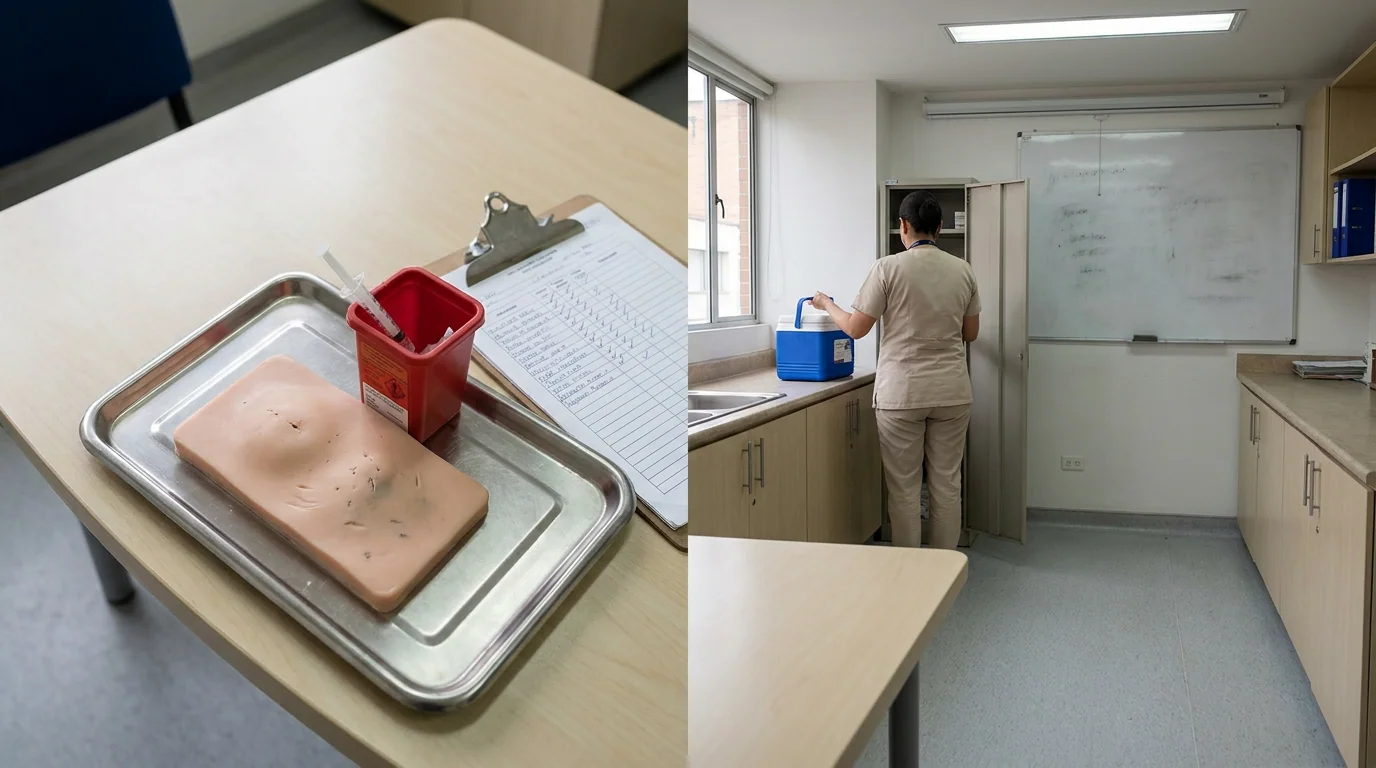
In health, the cost of a training gap is not a bad grade. It is a patient.
That is why Mi Campus started in health. We built the first version in 2021 with Emcodesa, a health-sector short-course provider, and the demands of that sector shaped everything that followed: short programs, practical skills, strict procedures, regulatory updates that arrive on a schedule nobody controls, and the permanent need to show that the people who completed a course can actually do what it taught.
Why health needs evidence, not attendance
Consider what a health institution typically trains: injectology, vaccination technique and cold chain, clinical record keeping, biosafety, updates to regulation. Each of these is a procedure or a set of rules that must be applied correctly every time. Partial knowledge is not partial credit; it is a risk.
Attendance-based training treats these skills like information. Watch the module, pass the quiz, receive the certificate. But knowing the steps of an aseptic technique and performing them in order under time pressure are different capabilities, and only the second one protects anyone. Institutions know this, which is why they add practical evaluations, sign-off sheets and supervised sessions around the online course. The online part measures consumption; the real evaluation happens somewhere else, often on paper.
Mi Campus brings the evaluation into the training itself. Three challenge types are especially suited to health. Cases put a learner in a clinical situation and ask for a reasoned response, evaluated against a rubric. Checklists reproduce the procedural discipline the sector already relies on: each step confirmed, order and completeness evaluated. Decisions isolate the single choice that matters, such as selecting the correct dose or identifying a contraindication, and record exactly which wrong choice was made when it was.
Every challenge leaves a record: passed or not against the institution’s criteria, attempts, time and errors. That record is the evidence.
From a syllabus to capsules and paths
Most health programs already exist as a syllabus: a list of topics, each with material and a final evaluation. Turning that into Mi Campus is a matter of decomposition rather than reinvention.
Start with the skills, not the topics. For a vaccination program, the skills might include verifying cold chain on receipt, screening for contraindications, preparing a dose, administering an intramuscular injection at the correct site, monitoring for adverse reactions and completing the vaccination record. Each one becomes a core capsule: a short lesson containing only what that skill requires, a challenge of the matching type, and the rubric and passing criteria the institution sets.
Then write the reinforcement capsules for the errors you already know people make. Instructors in health almost always know these: the site confusion, the missed screening question, the temperature log left blank. Each one gets a reinforcement capsule that stays hidden until a learner’s results show that error, and is then prescribed to that learner alone.
Finally, arrange the capsules in a path with prerequisites. A learner cannot open dose preparation until cold chain and screening are complete. The path enforces the order the procedure itself requires, and each capsule shows its state: not started, in progress, completed, needs reinforcement or locked.
The Reinforcement Hub then gives the program coordinator what a gradebook never did: activation rate per capsule, error patterns ranked by severity from low to critical, and a competency map showing which learners have mastered each skill, which are in progress and which are pending.
Certificates that can be checked
When a learner completes the core capsules of a program under the passing criteria, Mi Campus issues a certificate. The certificate carries a public link. An employer, a regulator or a clinical coordinator who receives it can open the link and confirm that it was issued by your institution, to that person, for that program.
This closes a gap that health institutions deal with constantly: certificates that are presented as PDFs, easily altered and impossible to check without calling the issuer. A verifiable link makes the certificate worth something to the person who holds it and to the person who has to trust it.
The certificate also means something different because of what stands behind it. It is not a record of attendance. It is issued because a defined set of challenges was completed under criteria your institution wrote, and the evidence of that exists.
Getting started
If you run a health training program, take one course and list the skills it is supposed to produce. For each skill, ask what a learner would have to do to prove they have it. That list is your core capsules. The mistakes you already correct in practice are your reinforcement capsules.
Mi Campus has a free plan to build and run that first program with real learners. Create your institution, build the first capsule with a checklist or a case, and see what the evidence tells you that the attendance sheet never did.